
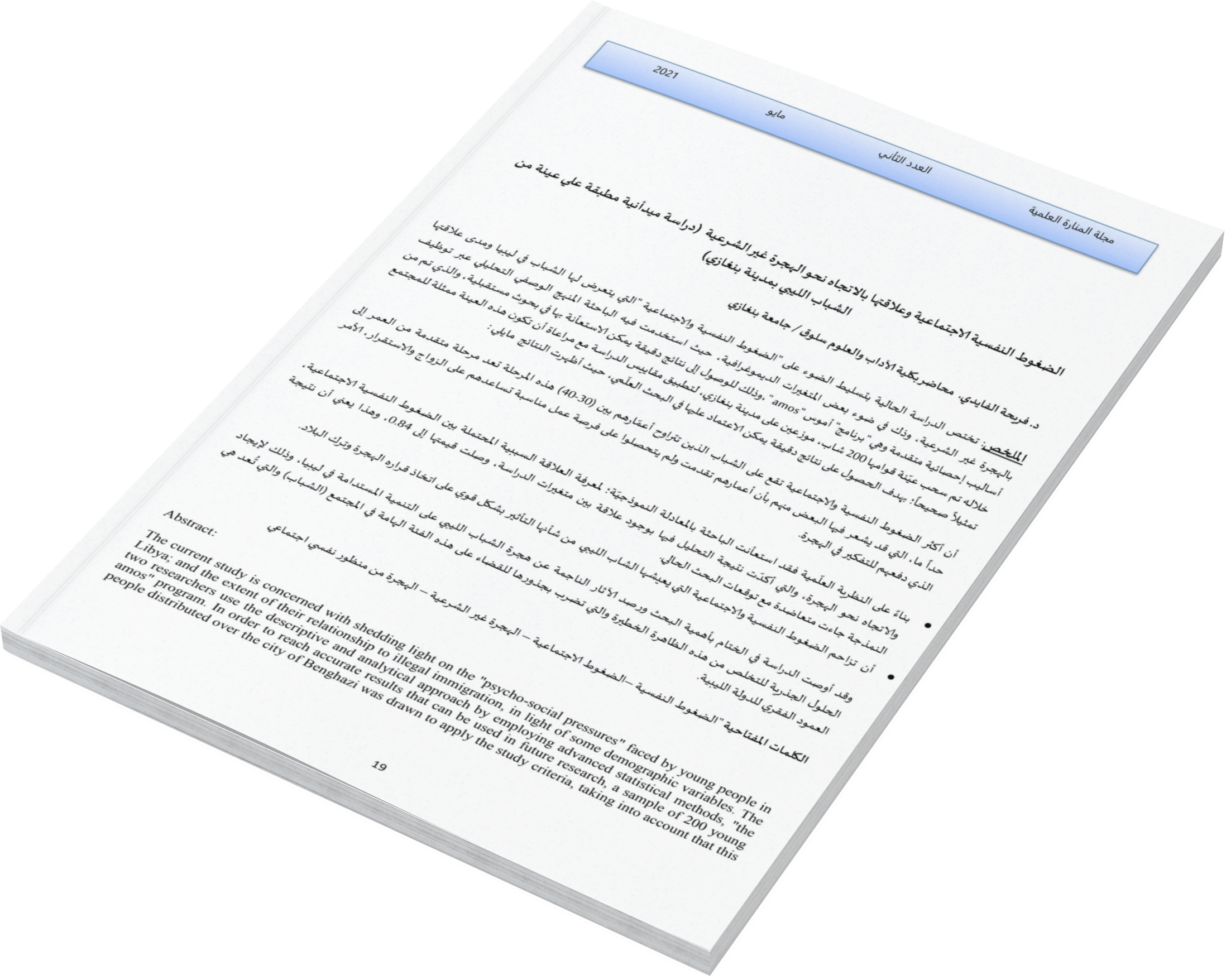
Psychosocial stress and its relationship to the trend towards illegal immigration (a field study applied to a sample of Libyan youth in Benghazi)
DOI:
https://doi.org/10.37376/asj.vi2.79Keywords:
Psychological pressures - Social pressures - Illegal migration - Migration from a socio-psychological perspective.Abstract
The current study is concerned with shedding light on the "psycho-social pressures" faced by young people in
Libya; and the extent of their relationship to illegal immigration, in light of some demographic variables. The
two researchers use the descriptive and analytical approach by employing advanced statistical methods, "the
amos" program. In order to reach accurate results that can be used in future research, a sample of 200 young
people distributed over the city of Benghazi was drawn to apply the study criteria, taking into account that this
sample is properly representative of society Aims to obtain satisfactory results for scientific research, the
results have shown the following:
•That the most psychological and social pressures fall on young people whose ages range between (30-40).
This stage is considered an advanced stage of life to some extent, and some of them may feel that their age has
advanced and did not get a suitable job opportunity to help them in marriage and stability. Urged them to think
about immigration.
Based on the scientific theory, the two researchers used the model equation. To find out the possible causal
relationship between psychosocial pressures and the trend towards migration, and the result of the analysis
confirmed the existence of a relationship between the study variables, whose value reached 0.84, and this
means that the modeling result was consistent with the expectations of the current research.
•That the crowding out of psychological and social pressures experienced by the Libyan young man would
strongly influence his decision to migrate and leave the country.
In conclusion, the study recommended the importance of studying and monitoring the effects of the migration
of Libyan youth on sustainable development in Libya, in order to find radical solutions to get rid of this
dangerous phenomenon, which strikes its roots to eliminate this important group in society, which is the
backbone of the Libyan state.
Downloads
Downloads
Published
How to Cite
Issue
Section
License
Copyright (c) 2021 Almanara Scientific Journal

This work is licensed under a Creative Commons Attribution-NonCommercial-NoDerivatives 4.0 International License.
Permitted third party reuse of the articles published by Almanara Scientific Journal is defined by the following international user license:
Creative Commons Attribution-NonCommercial-NoDerivatives 4.0 license (CC BY-NC-ND 4.0): This Allows users to download, copy, distribute, print, search, or link to the full texts of articles stored in the publications Archive, provided that this is done for non-commercial purposes. Distribution of the article is not permitted if it is changed or edited in any way. Reuser must give appropriate credit (i.e DOI link) to the formal publication, and provide a link to the license. The full details of the license are available at https://creativecommons.org/licenses/by-nc-nd/4.0/